Commercial mold remediation in Auburn means removing growth from a building people work or live in without spreading it to the rest of the property. On the Green River valley floor that often traces back to high water; on Lea Hill and West Hill it is more often a roof, window or plumbing leak. Call the number on this page to be connected with a local mold remediation company in Auburn.

Warning signs in a working building
- Several tenants or employees mention the same stale, earthy odor in a hallway, stairwell or back room.
- Brown rings or dark speckling on suspended ceiling tiles below a roof drain or rooftop unit.
- Baseboards, carpet tack strip or lower drywall that stayed damp after river water or a sprinkler line got in.
- Recurring spots in a unit's bathroom or closet that come back within weeks of cleaning.
- Growth covering more than about 10 square feet, the point where EPA points property owners to its guide for schools and commercial buildings.
Why Auburn properties get wet
Auburn lies about 22 miles south of Seattle, mostly in King County with a small piece of Lakeland Hills in Pierce. The Green and White rivers made flooding a constant concern until Mud Mountain and Howard A. Hanson dams were built, and the system still gets tested. In December 2025 the Green River at Auburn hit 68.7 feet, and a levee failure prompted King County evacuation orders in parts of Kent, Auburn and Tukwila. A ground-floor suite or storage room that took water then and was only surface-dried can hold moisture inside the wall cavity.
Uphill properties have a different pattern: months of rain, slow drying, and condensation on cold exterior walls in buildings that sit closed over a weekend or holiday. In ZIP code 98001, which covers part of Auburn and some surrounding land, about 41 percent of houses date to 1979 or earlier, so older roofs and supply lines are common on converted rentals and small office buildings.
Any repair inside the city's FEMA-regulated floodplain needs a City Floodplain Development Permit through Development Engineering, and Community Development Services oversees construction permits.
What shapes a commercial bid
- Total square footage of affected material and how many rooms or units are involved
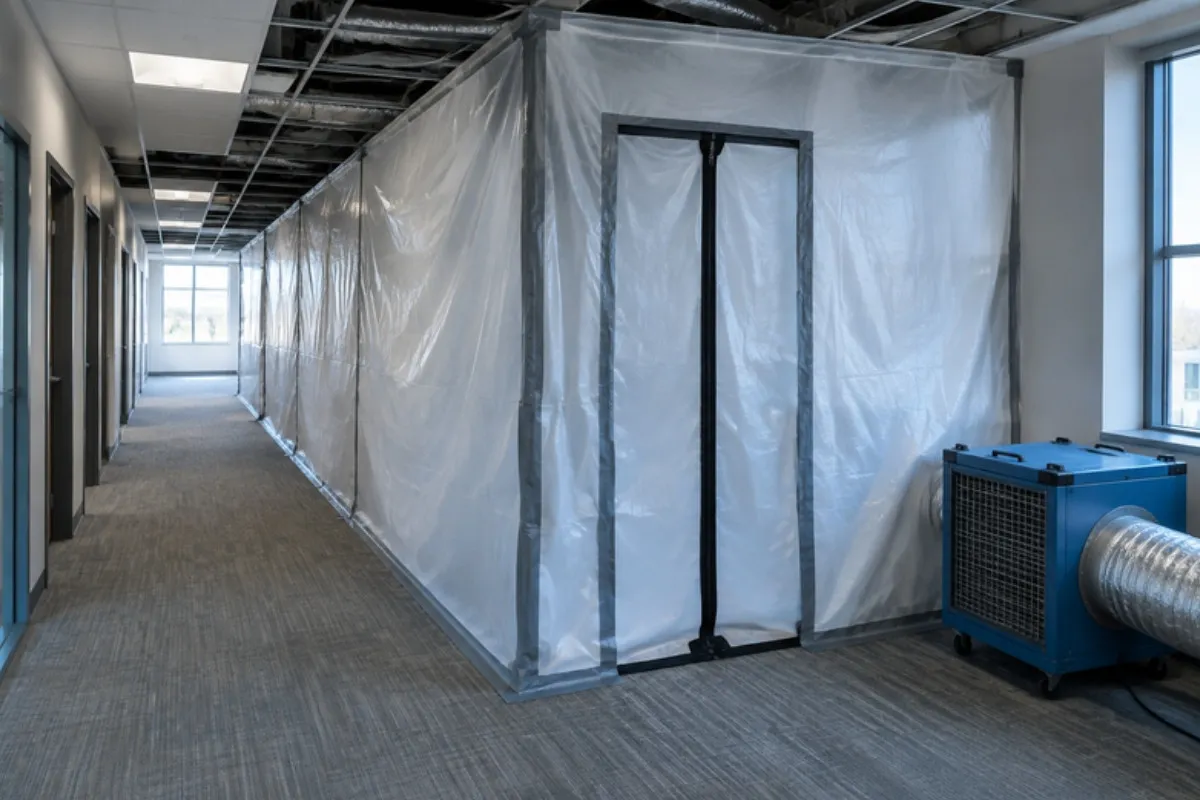
- Containment and air filtration needed to keep occupied areas clean
- Night or weekend scheduling to avoid closing a business
- Whether ductwork or a rooftop unit has to be checked or cleaned
- Build-back of drywall, flooring and ceiling grid
Angi's Seattle cost guide lists $10 to $25 per square foot for typical jobs, a residential figure that works only as a rough starting point for a larger building.
What happens when you call
Your call is routed to an independent local remediation company; this site is a referral line and does not do the work. Have the building type, the affected area and any recent water event ready. Expect a site visit and a written scope before any demolition. Washington has no state mold license, so verify that the company is registered with Washington L&I as a construction contractor on L&I's Verify a Contractor tool.
Commercial Mold Remediation questions in Auburn
How is the size of a commercial mold job judged?
Do we need a permit to rebuild after commercial mold removal?
Will our commercial property policy pay for mold cleanup?
Can the work be done after hours or in phases?
More mold services in Auburn
Commercial Mold Remediation nearby
Helpful guides
Sources
- Wikipedia: Auburn, Washington
- City of Auburn: Floodplain Management and Flood Information
- Washington Times: Levee fails after week of heavy rain, evacuations ordered in 3 south Seattle suburbs
- City-Data: ZIP 98001 housing
- EPA: Mold Remediation in Schools and Commercial Buildings (pdf)
- Angi: How Much Does Mold Remediation Cost in Seattle, WA?
- L&I: Verify a Contractor, Tradesperson or Business
- Washington DOH: Identifying an Unknown Indoor Air Quality Problem (hiring a contractor)
- EPA: Homeowner's and Renter's Guide to Mold Cleanup After Disasters (pdf)
Last updated: